Judge a Niche From the Outside: Clean-Session Research and the Systems Behind It
There was a period when publishing consistently was, on its own, close to a strategy. Post often enough for long enough and something would eventually catch. That window has closed, not because the platform turned hostile, but because production got cheap. When anyone can generate a competent video in an afternoon, competence stops being a differentiator and judgement starts being one.
The judgement that matters most happens before you make anything: deciding what the channel is about, and then building the unglamorous systems that let it survive its own success. Those are the two things I want to cover, because both are routinely skipped and both are expensive to fix later.
Your own recommendations are lying to you
Almost everybody researches a niche the same way. They open YouTube, search a few terms, look at what appears, and form an impression of the market.
The problem is that what appears is not the market. It is a feed assembled specifically for you, based on everything you have watched, paused, skipped and searched for years. If you have spent months watching videos about building channels, your homepage is a hall of mirrors reflecting your own interests back at you. It will show you a subject looks busy when it is niche, or quiet when it is crowded, and it will do that with total confidence.
The fix is unglamorous and it works: do the research in a session that knows nothing about you.
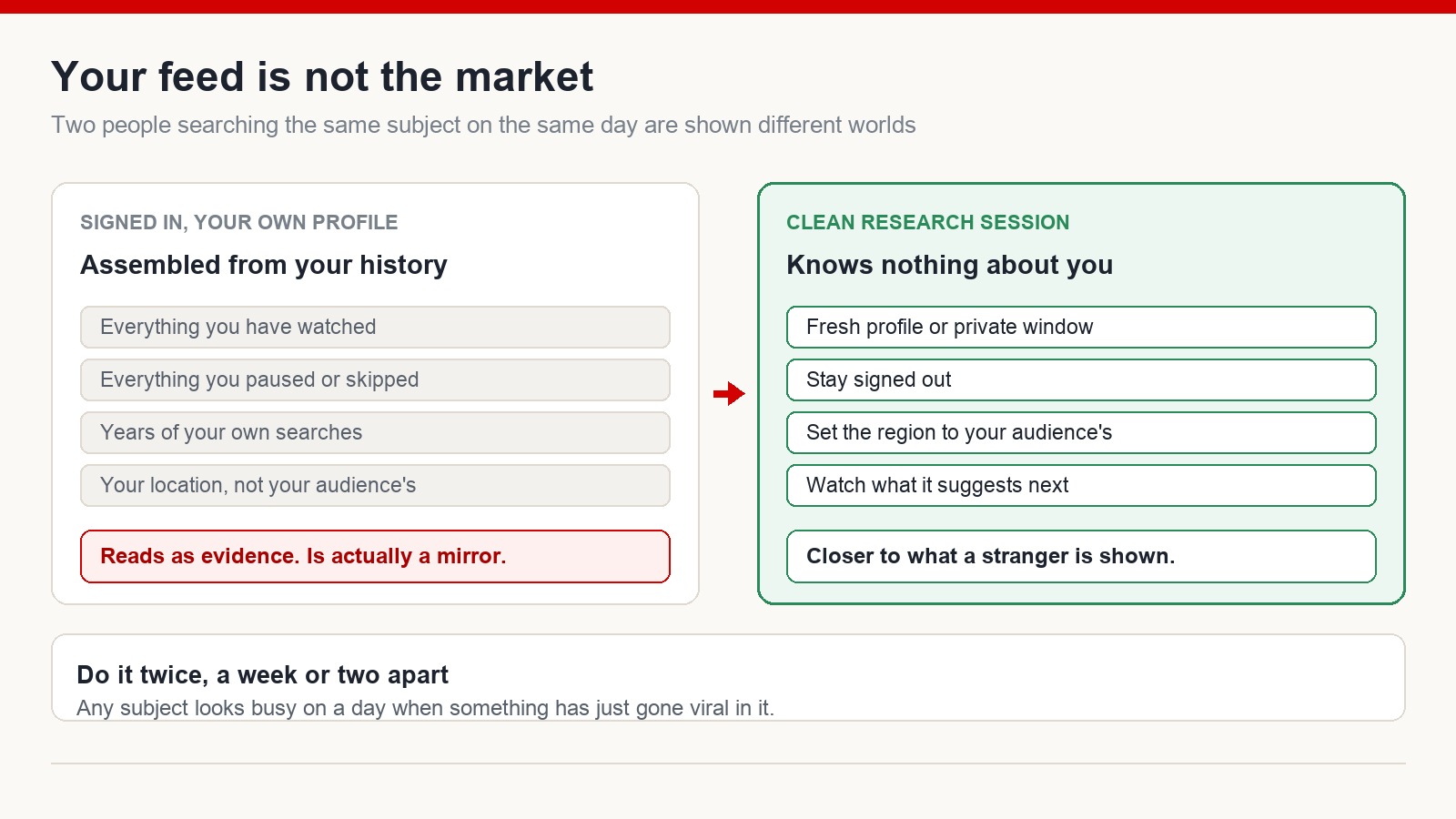
Use a fresh browser profile or a private window, stay signed out, and check that the region setting matches the audience you intend to serve – a signed-out session still defaults to where you are, not where they are. Then search your candidate subject and, crucially, watch what the platform offers you next. The sidebar and the follow-up suggestions are the interesting part, because that is the platform telling you what it thinks people who want this also want.
Do it twice with a gap of a week or two. Any subject can look busy on a day when something has just gone viral in it.
What you are actually looking for
People usually go into niche research hunting for low competition. I think that is the wrong target, and it is why so many people end up in subjects nobody is competing over for the very good reason that nobody is watching.
What you want is room – evidence that new entrants can still get traction. Four signals suggest it.
- New channels are visibly growing. If every channel surfacing in the space is old and established, the recommendation system has settled on its winners and a newcomer is fighting incumbency.
- Several recent videos have travelled, across several channels. Not one – several. One is an event, not a pattern.
- Demand is continuous rather than spiky. Search interest that persists across months beats a spike that already peaked, because the spike is somebody else’s timing, not yours.
- You can see an angle nobody has taken. If all ten of the videos you tore down make the same promise in the same way, the gap between them is your opening.
Three signals that fool people
Reading the evidence honestly is harder than gathering it, and there are three traps I keep watching people fall into.
The single viral video. One video with an enormous number on it does not indicate a healthy niche. Check the rest of that channel. If the video is an outlier for them too, you are looking at a lightning strike, not a climate.
The coasting incumbent. A large channel with steady views might be sustained by a back catalogue rather than by current demand. Look at what they have published in the last three months and how those specific videos did.
The reupload farm. A space that looks busy but is mostly the same material passed between accounts is not a market with room. It is a space that has attracted a particular kind of operator, and joining it puts you in competition on the one axis you should never compete on.
Spend the saved time on the script
Assume the research holds up and you have a subject. The obvious next move is to use your faster production process to make more videos. I would push back on that.
Speed of production has stopped being scarce. What is still scarce is a video that is genuinely well constructed – an opening that earns the next thirty seconds, sections that arrive in the right order, a thread that gives someone a reason to stay, an ending that does not just stop.
A drafting tool can hand you a serviceable outline in a minute. Turning that into something worth watching is still a person’s job, and it is where the hours saved elsewhere should go. In my experience the difference between a channel that grows and one that stalls shows up in the script long before it shows up in the thumbnail.
The operations layer nobody writes about
This is the part that gets ignored until the day it matters, and then it matters enormously.
A channel is not only a creative project. It is an account, a set of assets, and a set of obligations – and if you eventually run more than one, the mess compounds. The creators I know who have been doing this for years all keep some version of the same boring records.
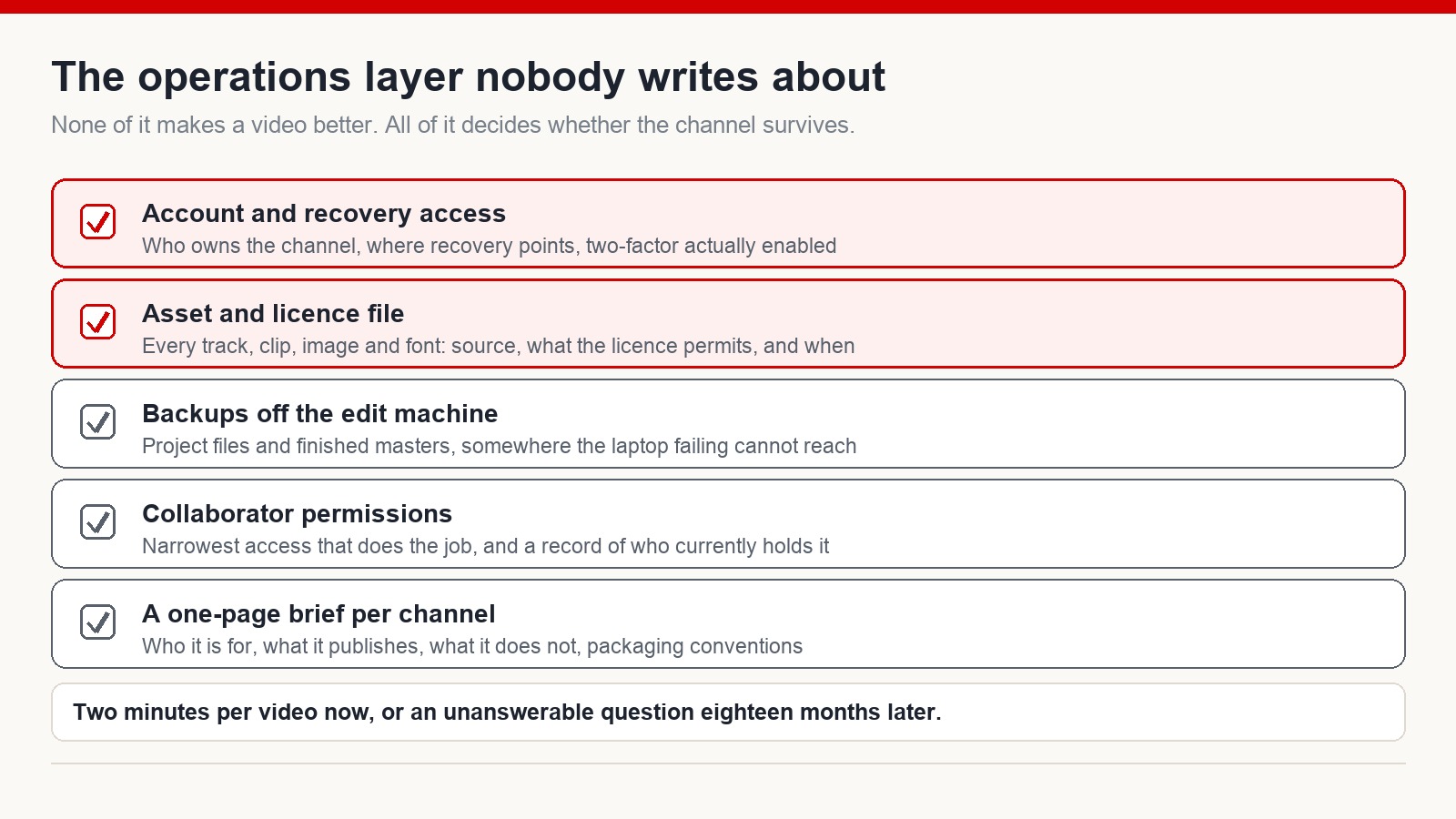
Account and recovery access. Which account owns the channel, where the recovery routes point, and whether two-factor authentication is genuinely enabled rather than intended. Losing access to an email address you no longer control is a mundane way to lose everything.
An asset and licence file. For every music track, clip, image and font: where it came from, what the licence permits, and when you obtained it. This takes two minutes per video and is the only thing that helps you if a claim arrives eighteen months later.
Backups. Project files and finished masters, somewhere that is not the machine you edit on. Storage is cheap. Re-editing a video you can no longer find is not.
Collaborator permissions. If anyone else touches the channel, they should have the narrowest access that lets them do their job, and there should be a record of who has what. Revoking access when someone moves on should be a checklist item, not an afterthought.
A one-page brief per channel. Who it is for, what it publishes, what it does not, and the packaging conventions. This is what lets you hand work over without the channel losing its shape.
None of it makes a video better. All of it makes the difference between a project and an operation.
Keep the majority evergreen
The last piece is what fills the calendar. Trends bring views quickly and stop bringing them just as quickly. Evergreen material – explanations, how-to work, problem-solving, things you learned by doing them – accumulates slowly and keeps accumulating.
So let the bulk of your library be evergreen, and treat topical material as a deliberate minority that brings new people in. The ratio is yours to choose, but the direction is not really debatable: a channel made entirely of trends has to win again every month, and one built mostly on durable subjects gets to keep what it earned.
What the tools will not do
I use AI throughout my own process and I would not go back. It has not, however, replaced any of the following: understanding an audience well enough to know what they will find interesting, telling a story with a shape, building the trust that makes someone watch a second video, and having a recognisable point of view.
Those remain the reasons a viewer chooses you over the several thousand other channels producing broadly similar material with broadly similar tools. Everything else has been commoditised, which is precisely why what has not been is worth more than it used to be.
Results still vary enormously between channels, and platform behaviour changes without notice. Nothing above is a guarantee – it is a way of being wrong less often and cheaply.
Frequently asked questions
Why research in a signed-out session?
Because a personalised feed reflects your own history rather than the market. A clean session shows you closer to what a stranger sees, which is who you are trying to reach.
Is low competition a good sign?
Not on its own. Empty spaces are often empty because demand is absent. Look for evidence that new channels are still gaining traction instead.
Should I publish more now that production is faster?
Only if quality holds. The scarce resource has shifted from production capacity to editorial judgement, and volume without judgement mostly produces a larger pile.
How many videos should I keep as backups?
Keep the project files and masters for everything you publish. The cost is trivial and the alternative is unrecoverable.
Do trends still matter?
Yes, as a minority of the schedule. They bring in new viewers. They just should not be what the library is made of.
If you want to work through this as a process rather than piece by piece, that is what we do at mmoyoutube.com.